


Lath
Oak, larch and chestnut lath for traditional walling and lath and plaster applications. Our lath measures 1.2m in length.
Price range: £0.58 through £141.64

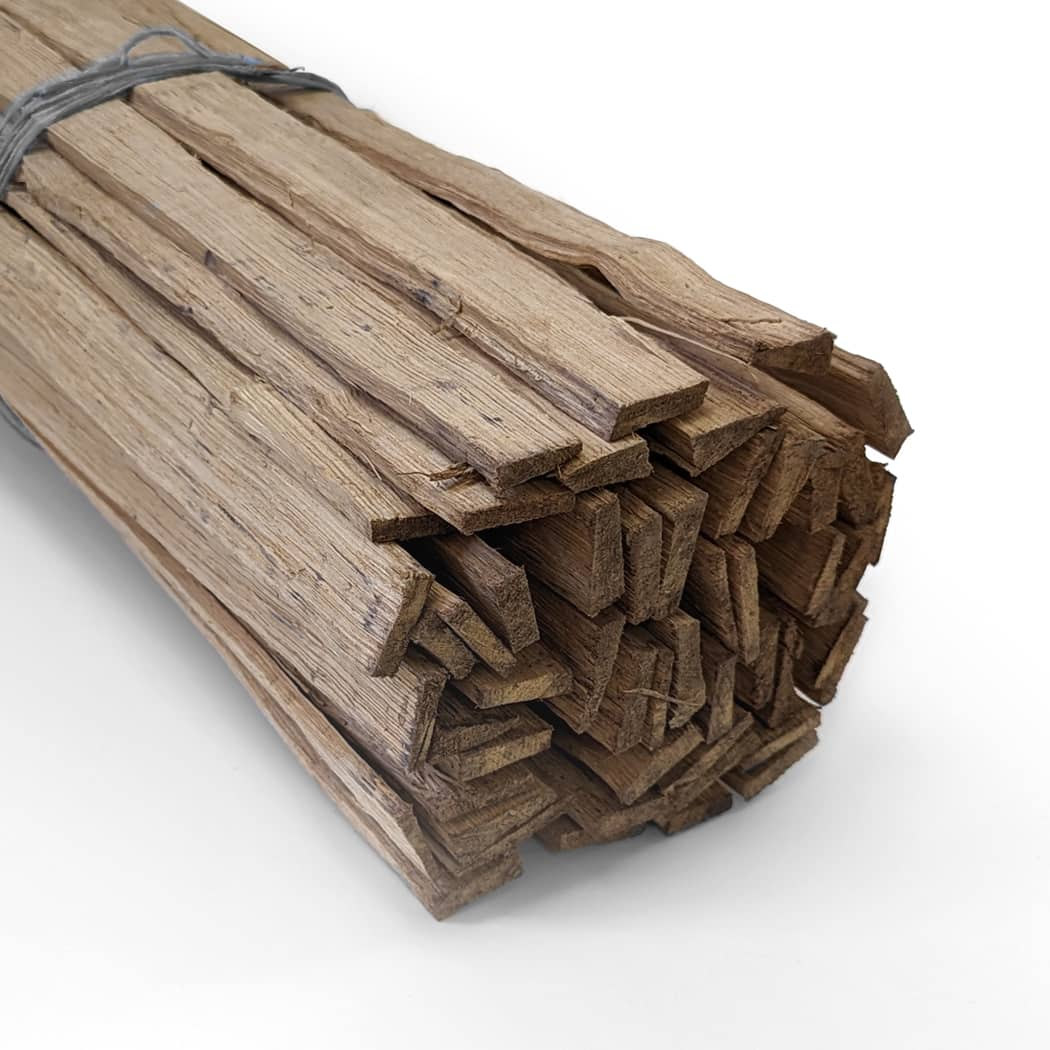
Oak, larch and chestnut lath for traditional walling and lath and plaster applications. Our lath measures 1.2m in length.
Price range: £0.58 through £141.64
Lath are thin strips of wood used as a key for lime plaster. Lath provides an ideal background for lime plasters as it can be wetted down which helps the slower drying of the plaster.
When the plaster has failed the lath can be clearly seen. Sometimes the laths need replacing because Lath can deteriorate over the years due to insect infestation or rot, especially if modern less breathable plasters or paints have been applied.
Sawn Larch Lath: Larch is a good quality flexible wood which can follow the uniformed contours of older walls.
Sawn Oak Lath: Oak is a popular choice of timber for the lath. Sawn lath is straighter with a less textured surface than split Lath and is best for repairing lathed walls.
Riven Oak Lath: The laths are split by hand (hence the cost) using traditional methods such as mauls and froes or riving knives along the length of the grain. The result is a thin strip of wood offering a textured fibrous surface offering a sound key for the lime plaster that is surprisingly strong and durable.
It is vital that the initial render coats applied onto lath include hair or fibre to improve the renders tensile strength.
See the Technical Data and Documentation section for detailed product information, application guidance, and datasheets. Always review any available documents before use. Each project is unique, always seek professional advice before undertaking a project.
Always read any available datasheets and documentation before use.
Stock Quantities and Lead Times
Stock quantities and lead times are estimated and may differ or increase based on the order size and shipping method. If your timeline is sensitive, get in touch with the team.
Palletforce
Pallet orders with Palletforce Economy are typically dispatched from Cornish Lime within 1-2 business days, providing your item is in stock and not made-to-order. Once dispatched, Palletforce will deliver your order within 3-5 business days, depending on your location. Please ensure that your site can accommodate articulated lorries or similar-sized vehicles.
Local Delivery
The Cornish Lime team provides local delivery with a 18-tonne vehicle with a crane to assist with unloading. You will be contacted by phone to arrange delivery and ensure your site can accommodate our vehicle.
APC Parcel Courier
Orders shipped by APC parcel courier are typically shipped the next business day and arrive within 2-3 business days, providing your item is in stock and not made-to-order. APC will contact you via email with delivery information, and orders can be tracked on the APC website.
Premium or Expedited Service
For a premium or expedited delivery service, please get in touch to discuss if this option is available for your order.
For further information, see our delivery information page.

A lath strip or slat can is made from various types of wood. It’s not uncommon to find Oak, Chestnut or Larch, which we stock here.
There are two main types of wooden lath, Riven or Sawn. Riven or Split Laths are split by hand along the length of the grain, providing an ideal textured fibrous surface with a greater surface area than its rival for lime plaster. Sawn Laths are machine cut, thanks to the invention of the circular saw in the 18th-Century and are considered more straightforward to fix into place due to their uniform shape or form, especially for ceilings.
The size of your space, the size of the lath and the gap between the laths will determine how much you will need. Our lath is available in 50-length bundles or as individual lengths to suit your required amount. As a general guide, the gap between laths can be between 6 and 9mm depending on the lath, with 6 mm or 1/4 of an inch as a good starting point. However, remember that the goal of the spacing is to ensure a large enough gap has been left between the laths so that the lime plaster is pushed through effectively to form a key, often called nibs or rivets. If spaced too closely, the plaster is unlikely to go through and easily fail due to the lack of an effective mechanical bond to the lath. If the spacing is too wide, the plaster may fall through the back, inhibiting an effective bond and causing an excessive amount of material to be used unnecessarily.
In a nutshell, the invention of plasterboard. The application of wooden lath and plaster evolved from the ancient practice of “Wattle and Daub” and was widely used until the middle of the 20th Century. While this method had many benefits, such as fire and mould resistance, heat insulation, and soundproofing, in reality, its popularity was driven by limited alternatives that performed the same function. With the invention and production of plasterboard, which was less expensive and simpler to install, its use steadily declined.
Wattle and Daub is a very traditional method of making and finishing walls and buildings, used for at least 6,000 years. With this method, a woven lattice of wooden strips called “wattle” is formed and then “daubed” with a sticky material, typically a blend of wet soil, clay, sand, animal dung, and straw. Wattle and Daub has been and is still an important construction method in many parts of the world.
While Expanded Metal Lath is a common material for cement or gypsum plasters, we generally advise against its use for traditional lime plasters.
Reviews
There are no reviews yet.