

Use of bonding coats vs. primers before lime plaster
A common question we receive is whether a bonding coat or primer is necessary before applying lime plaster. Below are a handful of the options we are often asked about and their advantages and disadvantages worth considering.
Using Bluegrit, Redgrit or Rendaid
Paint-on polymer-based primer coats are generally unsuitable for use with lime work. We frequently see these materials being applied onto plasterboard, where a lime plaster aesthetic is required to match the other areas of a room and this is generally ok.
Materials such as these shouldn’t be used on solid walls as they are film-forming, which means they create a barrier preventing breathability or the ability for moisture to move or pass in and out of the building fabric. As lime is breathable, when used on solid walls it requires this function for moisture to able to move to manage moisture, it’s clear why this approach is counter intutive or inadvisable.
Generally, we could consider it a better practice to use a render carrier board, such as Celenit N, along with a lime render basecoat before the application of a finer finishing plaster. Although a less budget-friendly option, this allows the lime plaster to pull into the surface and stiffen. This provides a stronger, harder plaster that will make getting a smooth, even, and all-around better finish easier to achieve.
Further, this approach also retains the wall’s breathability. While this may not be as critical in partition walls, it helps to prevent moisture from becoming trapped where a partition wall may adjoin an external wall. If insulating boards like the Celenit N are used, this can also support the retention of heat in specific rooms, which can reduce the cost of heating, and assist with managing relative humidity.
Learn more about insulating older buildings
Beeck Plaster Primer
Unlike Blue Grit or Rendaid, Beeck Plaster Primer is a viable option worth considering for lime renders or plasters. With an SD value of 0.1, this primer will reduce some breathability of lime plaster but will provide a permanent and more even alkaline-resistant bond for challenging high or low-absorbancy backgrounds.
With a grippy slurry-like grain texture, the primer can even out differing absorption and texture defects and improve adhesion on smooth substrates with no key, high or low absorbancy backgrounds or organically modified surfaces. Learn more about Beeck Plaster Primer.
Lime slurrying
When applying render or plaster onto challenging surfaces such as high-suction brickwork, a painted slurry of lime on the wall can help to reduce the suction and increase the bond to the background.
When making a slurry, we recommend using the same strength of lime as the next render or plaster coat. In short, an NHL2 lime render basecoat should be paired with an NHL2 slurry. Browse our range of lime and binders.
A quick top tip
When creating a slurry, we typically advise aiming for consistency, like that of thin milk. If the slurry is too thick, it risks reducing the bond strength, as the slurry will want to shrink behind the render. Furthermore, it will be difficult to get the render on at the correct depth, as it’ll want to slide around on the wall.
Once your slurry is prepared to the correct consistency, paint it onto the wall with a paintbrush. The slurry should be allowed to pull in briefly but not dry. Then, proceed with laying the lime render straight onto this, a couple of square meters at a time maximum on the high-suction background.
If the slurry is allowed to dry before the render is laid into it, the opposite effect can occur, reducing the bond with the background. So, keep a close eye on your slurry after it’s applied to the wall.
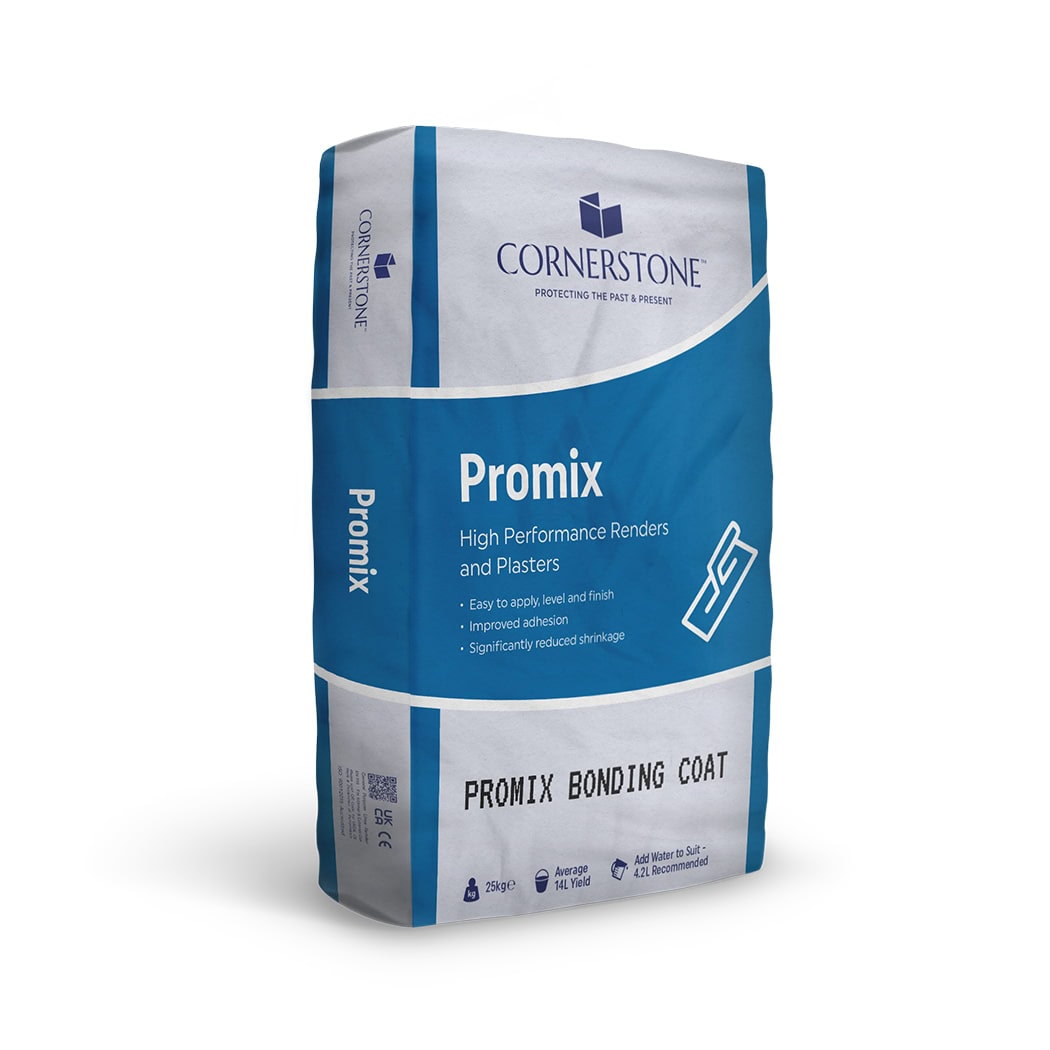
Promix Bonding Coat Render
Using a premixed lime render designed specifically as a bonding coat can be a convenient and reliable option. We recommend Cornerstone Promix Bonding Coat Render, which has been engineered with additional enhanced plasticity to decrease the likelihood of slump and improve adhesion. Further, a longer open time makes this render straightforward to apply, level and finish.
Learn more about Cornerstone Promix Bonding Coat Render and Plaster
Polyvinyl alcohol – PVA
PVA is generally unsuitable for use with lime. It’s water-soluble and can emulsify over time, eventually causing plaster to debond. It’s also film-forming, so it is not considered a breathable approach.
Styrene Butadiene Rubber – SBR
SBR is a more chemically stable glue that can be used instead of PVA in specific applications. However, like other options on this list, it is not considered breathable as it is film-forming.
In scenarios where breathability is not relevant SBR would be the bonding agent of choice. SBR can be suitably watered down and slurried or added to the water intended to be mixed with the mortar or render.

Harl coat
Harling is a Scottish term for a method of throwing or spraying a highly textured render onto a wall. As a coat, referred to as a Harling Coat, this can be used as a type of bonding coat to assist with challenging low or high-suction backgrounds.
A harl coat is typically mixed a little more binder-rich than the basecoat and often has extra added grit in it to give a coarse finish for the basecoat to key into. See our harling grit as an example.
By throwing the material onto the wall, the quantity of air trapped between the render and the wall is reduced, improving the bond’s overall quality. Further, this also keeps the coat relatively thin, meaning that there is little weight to slump. Need to harl? Grab the handy RST Harling Trowel.
Harl coats should be left longer than a typical render coat before recoating. While this can vary, we generally advise 2 or more weeks. During this period, the harl coat should be kept damp and cured; this is especially important on high-suction substrates like old brickwork.
We often recommend utilising hessian sheeting to act as a barrier between the freshly applied lime and the environment and damp hessian to keep the relative humidity high next to the wall. This allows for a slower water evaporation rate from within the lime render and can help prevent cracking and shrinkage.
Shop Lime Renders and Plasters
Summing it up
Whether to use a bonding coat or primer will depend on several factors, including the background, the budget, and how important maintaining the breathability of the lime plaster is to your project. Each option has its range of advantages and disadvantages. When in doubt, consult a professional before proceeding with your project.